Your Travel Partner
SINCE 1989
Your Travel Partner
SINCE 1989
Delhi – Mandawa – Bikaner – Jaisalmer – Jodhpur – Ranakpur – Udaipur – Pushkar – Jaipur – Agra – Delhi
A journey across Rajasthan becomes far more revealing when it reaches beyond its famous capital cities and follows the old trading towns, desert strongholds and smaller cultural centres that once connected the region. The Exotic Rajasthan Tour 13 Days – Desert, Palaces & Taj Mahal has been shaped around such a route. Beginning in Delhi, it enters Rajasthan through the painted havelis of Mandawa before continuing across Bikaner and the desert landscape towards Jaisalmer. From there, the journey turns towards Jodhpur and southern Rajasthan before eventually reaching Pushkar, Jaipur and Agra.
The first half of the itinerary is strongly influenced by Rajasthan's historic desert geography. Mandawa represents the merchant heritage of the Shekhawati region, where successful trading families commissioned elaborately painted mansions. Bikaner introduces a former princely capital surrounded by arid country, while Jaisalmer takes the journey farther west to a city whose golden sandstone fort once stood along important caravan routes. These destinations reveal that Rajasthan's history was shaped not only by kings and battles but also by commerce, migration and the communities that prospered along desert trading networks.
From Jaisalmer, the architectural mood changes again in Jodhpur, where Mehrangarh Fort towers above the blue-painted quarters of the old city. The journey then turns towards the Aravalli region, stopping at Ranakpur for its celebrated Jain temple before reaching Udaipur. Here the dry expanses of western Rajasthan give way to hills and lakes, and the fortified character of Jodhpur is replaced by the palaces and waterfront architecture associated with the rulers of Mewar.
The latter section connects Pushkar's sacred lake with the royal heritage of Jaipur before crossing into Agra for the Taj Mahal. This progression gives the itinerary considerable variety without losing geographical continuity. Desert cities, merchant havelis, Jain temples, Rajput forts, pilgrimage traditions, Mughal architecture and traditional bazaars all belong to the same journey, but each appears in a different setting.
For travellers looking for a 13-day Rajasthan tour, the route offers a broader view of the state than itineraries restricted to Jaipur, Jodhpur and Udaipur. The inclusion of Mandawa and Bikaner adds Shekhawati and northern desert heritage, while two nights each in Jaisalmer, Udaipur and Jaipur provide greater depth at key destinations. Ending in Agra places the Taj Mahal near the culmination of the holiday rather than at its beginning, creating a memorable final architectural chapter after nearly two weeks of Rajasthan travel.
Arrive at Delhi International Airport, where assistance will be provided for your transfer to the hotel. Delhi serves as more than a convenient arrival point for this itinerary. For centuries, the city occupied a central position in the political history of northern India, and successive dynasties left behind forts, tombs, mosques, ceremonial avenues and entire urban districts. The contrast between these historical layers and the modern capital creates an appropriate introduction before travelling into Rajasthan the following morning.
After completing the hotel check-in, allow time to rest after the international journey. The programme on the first day remains intentionally measured because flight schedules vary considerably and many overseas visitors arrive after several hours of travel. If your arrival is early enough, a short orientation drive may provide initial views of New Delhi's broad avenues, prominent public buildings and busy commercial areas without turning arrival day into a full sightseeing programme.
The evening is left at a comfortable pace so that you can prepare for the road journey ahead. Over the next twelve days, the scenery will change repeatedly—from Delhi's metropolitan landscape to Shekhawati's painted mansions, the desert country of Bikaner and Jaisalmer, Jodhpur's rocky fortifications and Udaipur's lakes. Beginning with a quiet first night allows the tour to move into this longer Rajasthan circuit without unnecessary fatigue.
Overnight stay in Delhi
Have breakfast and leave Delhi for Mandawa, travelling towards the Shekhawati region of Rajasthan. This part of the state developed a cultural identity quite different from the large royal capitals farther south and west. Merchant families who became prosperous through trade commissioned substantial havelis in towns throughout Shekhawati, decorating their façades and interior courtyards with elaborate painted scenes. As a result, the region is often associated with Rajasthan's distinctive tradition of frescoed merchant architecture.
Arrive in Mandawa and check into the hotel before setting out to see the historic town. Walking through the older quarters reveals façades covered with paintings, ornamental balconies, carved doorways and enclosed courtyards. The havelis were built as private residences rather than royal palaces, and their architecture provides valuable insight into the wealth and social position of merchant communities. Painted subjects vary widely, with traditional religious imagery appearing alongside scenes influenced by changing fashions and contact with the wider world.
Spend the later part of the day among Mandawa's quieter lanes and heritage surroundings. Compared with Jaipur or Jodhpur, the town is smaller and more intimate, allowing architectural details to be observed at close range. Mandawa Fort and the surrounding old settlement contribute to the character of the destination, but the real appeal lies in the collective streetscape created by numerous historic mansions. The overnight stay ensures that Shekhawati becomes a meaningful part of the journey rather than a brief photographic stop.
Overnight stay in Mandawa
Leave Mandawa after breakfast and continue towards Bikaner, moving deeper into Rajasthan's northern desert belt. The changing surroundings provide a clear transition from Shekhawati's merchant towns to the territory of another former princely state. Founded in the fifteenth century, Bikaner developed in an environment where water, trade routes and military security were crucial. Despite the demanding geography, the city became an important royal and commercial centre.
After reaching Bikaner and completing hotel check-in, visit Junagarh Fort, one of the city's most important historical landmarks. Unlike many of Rajasthan's famous forts, Junagarh does not stand on a dramatic hilltop. Its strength comes instead from formidable walls and defensive planning surrounding an extensive palace complex. Passing through the gateways leads to a succession of courtyards, halls and royal chambers developed by different rulers over several generations.
Inside the fort, decorative styles range from finely carved stonework to richly ornamented palace interiors. The contrast between the military exterior and elegant inner buildings is one of Junagarh's most striking features. If time permits, continue through sections of Bikaner's old city, where historic mansions, temples and commercial lanes reflect its past as a desert trading centre. After a day that has moved from Shekhawati's merchant heritage to the royal architecture of Bikaner, return to the hotel.
Overnight stay in Bikaner
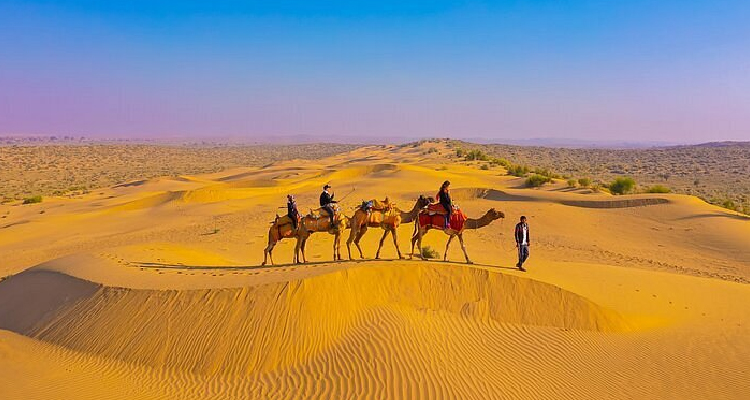
After breakfast, depart Bikaner for the longer drive to Jaisalmer. Today's road journey is important to the character of the tour because it crosses a broad stretch of Rajasthan's arid western region. Towns become less frequent, vegetation grows sparser and wide horizons dominate the scenery. These landscapes help explain why fortified settlements became so important historically and why control of trade routes was a major source of wealth for desert kingdoms.
As the journey progresses westward, the environment increasingly reflects the conditions of the Thar Desert. Scattered villages and hardy vegetation appear between long stretches of open country, giving travellers an opportunity to see Rajasthan beyond its major tourist cities. The road also creates a sense of geographical distance before Jaisalmer appears, something that is lost when the destination is reached by a quick flight rather than as part of an overland Rajasthan circuit.
Arrive in Jaisalmer and transfer to the hotel. The city's golden-yellow sandstone architecture immediately distinguishes it from Mandawa and Bikaner. Depending on the arrival time, the evening can be spent resting or taking a short walk through nearby market areas for a first impression of the Golden City. The main fort, Jain temples and havelis are deliberately reserved for the following day, when they can be visited without the pressure of a long preceding drive.
Overnight stay in Jaisalmer
Begin the morning at Jaisalmer Fort, which rises above the surrounding city like an extension of the desert itself. Constructed from yellow sandstone, the fort changes in appearance as sunlight moves across its walls. More importantly, it remains a living urban space rather than an empty defensive monument. Homes, temples, shops and narrow lanes continue within the fortifications, giving visitors an opportunity to see how a historic citadel has remained part of everyday city life.
Walk through the gateways and explore the lanes leading towards the fort's Jain temples and historic residential areas. The temples contain intricate stone carving, with pillars, ceilings and sculptural details demonstrating exceptional craftsmanship. Moving through the fort on foot reveals small squares, viewpoints and tightly packed sandstone houses that cannot be appreciated from outside its walls. From elevated positions, views extend over the lower city and towards the desert landscape beyond.
Later, visit some of Jaisalmer's celebrated merchant havelis, where wealthy trading families displayed their prosperity through remarkably detailed architecture. Patwon Ki Haveli is especially noted for its carved sandstone façade, projecting balconies and decorative screens. These residences reveal another side of Jaisalmer's history: the city was not sustained only by royal authority but also by merchants whose trade connections generated substantial wealth. Spend the evening at leisure after a full day among the fort, temples and historic streets.
Overnight stay in Jaisalmer
Depart Jaisalmer after breakfast and begin the drive towards Jodhpur. The route continues through western Rajasthan but leads towards a city with a markedly different historical personality. Jaisalmer's identity developed around its desert trading position, whereas Jodhpur became the powerful political centre of Marwar. The road between them allows the desert scenery to remain part of the journey while gradually approaching the rocky landscape surrounding Jodhpur.
Reach the city and transfer to the hotel before beginning the principal sightseeing, subject to the arrival schedule. The most commanding landmark is Mehrangarh Fort, which rises directly from a massive rocky outcrop above the old city. Its walls appear almost to merge with the cliff beneath them. Enter through the fortified gateways and proceed into palace courtyards where the architecture shifts from severe defensive construction to delicately decorated royal interiors.
From the upper sections of Mehrangarh, look across Jodhpur's famous blue neighbourhoods and the broader plains beyond the city. Continue to Jaswant Thada, the marble memorial located near the fort, before returning towards the historic centre. If time permits, spend the evening around the Clock Tower and traditional market streets, where spices, textiles and local handicrafts fill small shops and stalls. Jodhpur's mixture of fortress architecture and active old-city life provides a strong contrast to Jaisalmer.
Overnight stay in Jodhpur
Have breakfast and leave Jodhpur for Udaipur, travelling through one of the most attractive geographical transitions on the itinerary. The dry terrain around Marwar gradually changes as the route approaches the Aravalli hills. Instead of driving directly to Udaipur, stop at Ranakpur, where an extraordinary Jain temple complex stands in a peaceful valley surrounded by hills and vegetation.
The principal temple at Ranakpur is celebrated for its elaborate marble construction and extensive series of carved pillars. Step inside and the architectural emphasis changes completely from the massive walls of Mehrangarh seen the previous day. Here, visual impact comes from intricate craftsmanship, balanced spaces, domed ceilings and the play of natural light across pale stone. The temple remains an active religious site, so the visit is conducted with respect for applicable customs and entry regulations.
Continue afterwards through the Aravalli landscape towards Udaipur, the historic capital of Mewar. Lakes and hills begin to shape the surroundings as you approach the city, creating a greener setting than the desert region crossed earlier in the tour. On arrival, check into the hotel and keep the evening relaxed. After several days among Shekhawati towns and desert cities, Udaipur introduces a softer landscape where palaces, old neighbourhoods and water are closely intertwined.
Overnight stay in Udaipur
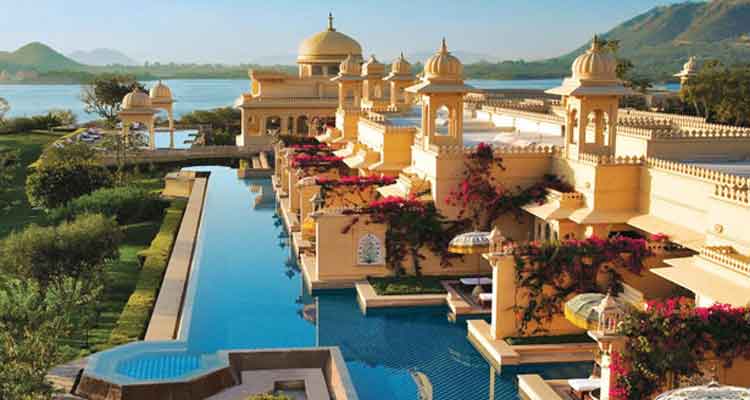
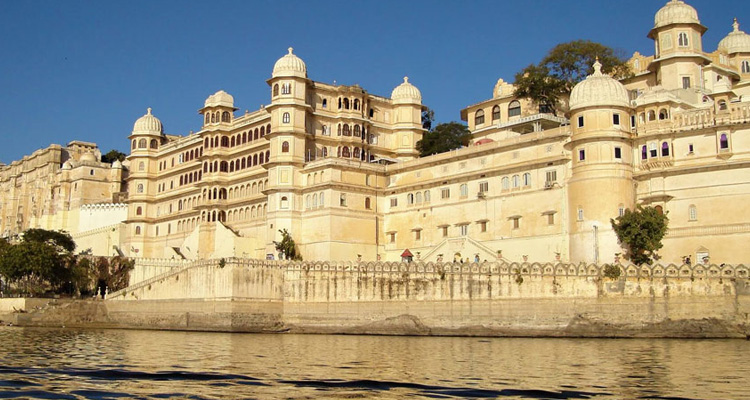
Begin the day at Udaipur City Palace, an extensive royal complex built and enlarged over several generations of Mewar rulers. Its position above Lake Pichola is central to its appeal, with balconies and terraces opening towards water, hills and the dense old city. Rather than following a single architectural plan, the palace developed gradually, resulting in interconnected courtyards, corridors, chambers and gateways that reflect different periods of Mewar's royal history.
Inside the palace complex, spend time observing decorative elements, historic rooms and viewpoints that reveal the relationship between the royal residence and the city below. Continue through Udaipur's old quarter to Jagdish Temple, where religious activity remains part of daily life. The lanes surrounding the temple and palace are lined with shops, small businesses and traditional buildings, making this area equally valuable for understanding the present character of Udaipur.
Later, visit Saheliyon Ki Bari, whose landscaped gardens, fountains and pavilions create a quieter contrast to the scale of City Palace. The remainder of the day can be spent around the historic lakefront and older neighbourhoods, allowing time to appreciate Udaipur without turning the programme into a sequence of hurried stops. As evening approaches, the palaces and ghats around the water take on a different character in the softer light.
Overnight stay in Udaipur
After breakfast, leave Udaipur and travel north towards Pushkar, exchanging the lake-filled surroundings of Mewar for one of Rajasthan's most important pilgrimage towns. The drive carries you away from the southern Aravalli region and gradually introduces a drier landscape as the route approaches central Rajasthan. After several days dominated by forts, royal residences and merchant architecture, Pushkar changes the character of the journey. Its importance comes not from a former royal court but from centuries of religious tradition centred on its sacred lake.
Arrive in Pushkar and check into the hotel before proceeding towards Pushkar Lake. A series of ghats surrounds the water, with temples and old buildings rising through the lanes behind them. Pilgrims continue to visit the lake for prayers and religious rituals, making the area a living sacred space rather than simply a historical attraction. Walk carefully through the ghat surroundings while respecting local customs, then continue towards the Brahma Temple, the best-known religious landmark in the town and an important part of Pushkar's spiritual identity.
Later, wander through the compact old market, where textiles, handicrafts, jewellery, clothing and religious items are sold from small shops lining the narrow streets. Pushkar's pedestrian-friendly centre creates an opportunity to enjoy the destination at a slower rhythm after the longer road sectors of the previous days. Towards evening, return to the lake area or spend some quiet time around the town before heading back to the hotel.
Overnight stay in Pushkar
allowing arrival with enough time to become acquainted with Jaipur before the main sightseeing programme on the following day. Founded by Maharaja Sawai Jai Singh II, Jaipur was conceived as a planned capital with organised streets, market areas and distinct urban sectors, giving it a different structure from the older fortified cities already visited on this tour.
After reaching Jaipur, transfer to the hotel and complete check-in. Later, head towards the old city for an introductory look at its characteristic architecture and commercial districts. The famous pink-toned façades, historic gateways and long market streets create a distinctive urban identity. Depending on available time, pause near Hawa Mahal, whose remarkable façade of projecting windows has become one of the defining architectural images of Rajasthan.
Use the remaining hours to see Jaipur at street level rather than attempting to complete the next day's major attractions in advance. Traditional bazaars specialise in jewellery, gemstones, textiles, block-printed fabrics, handicrafts and decorative products, reflecting craft traditions that remain closely associated with the city. The evening provides an easy transition from quiet Pushkar to the energy of Rajasthan's largest heritage capital. Return to the hotel after spending time in the old quarters.
Overnight stay in Jaipur
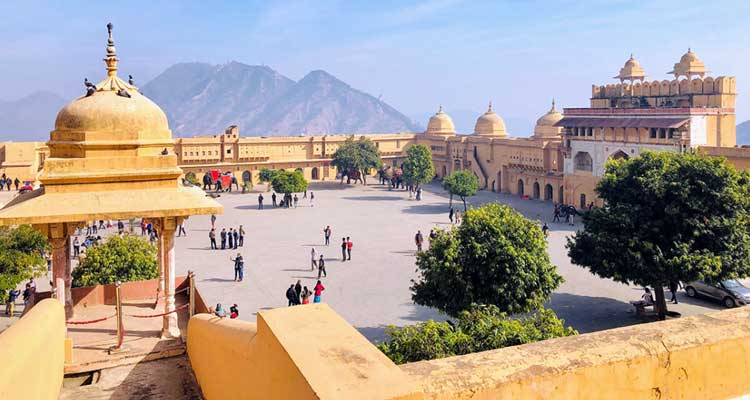
Begin the morning at Amber Fort, located among the hills outside central Jaipur. Amber served as the royal seat of the Kachwaha rulers before the establishment of Jaipur and contains an impressive combination of defensive architecture and elegant palace design. Move through fortified gateways into broad courtyards and decorated royal sections, where carved stone, mirror work, balconies and private chambers reveal a level of refinement hidden behind the imposing outer walls. Views towards Maota Lake and the surrounding hills further emphasise the fort's carefully chosen location.
Return to the old city and visit City Palace, a complex of courtyards, gateways, palace buildings and museum spaces closely connected with Jaipur's royal family. Its architecture provides another perspective on Rajasthan's court traditions after the very different palaces seen in Jodhpur and Udaipur. Continue to nearby Jantar Mantar, where enormous masonry instruments were constructed for astronomical observations. Their scale and mathematical precision reflect Maharaja Sawai Jai Singh II's scientific interests as well as his role as Jaipur's founder.
The afternoon can be used to return to the old bazaars and neighbourhoods at a more leisurely pace. Jaipur's historic commercial areas remain known for jewellery, fabrics, traditional crafts and colourful market displays, while the planned streets and surviving gateways preserve the structure of the original city. With two nights allocated to Jaipur, the programme allows the royal capital to be appreciated without compressing its major sights into the same day as an intercity transfer.
Overnight stay in Jaipur
After breakfast, leave Jaipur and travel towards Agra, crossing from Rajasthan into the region associated with some of the most important monuments of the Mughal period. Along the way, stop at Fatehpur Sikri, the former imperial capital established by Emperor Akbar. Although the Mughal court occupied the city for a relatively short period, its surviving palaces, courtyards, audience spaces and religious buildings form one of the most complete historic complexes on this route.
Walk through the red sandstone structures and examine the architectural variety found across the former capital. Buildings associated with court administration stand beside royal residential areas and ceremonial spaces, while finely worked pillars, screens and stone details demonstrate the craftsmanship employed during Akbar's reign. The scale of Fatehpur Sikri gives a sense of the political ambitions behind its creation and provides useful historical context before reaching Agra, another major centre of Mughal power.
Continue to Agra and check into the hotel before visiting Agra Fort, subject to the arrival schedule and final sightseeing arrangements. Behind its immense red sandstone walls lies a complex of palaces, courtyards and halls developed by successive Mughal emperors. The fort is also closely connected with Shah Jahan, whose architectural legacy will become the focus of the following morning. After the visit, return to the hotel and spend the evening at leisure.
Overnight stay in Agra
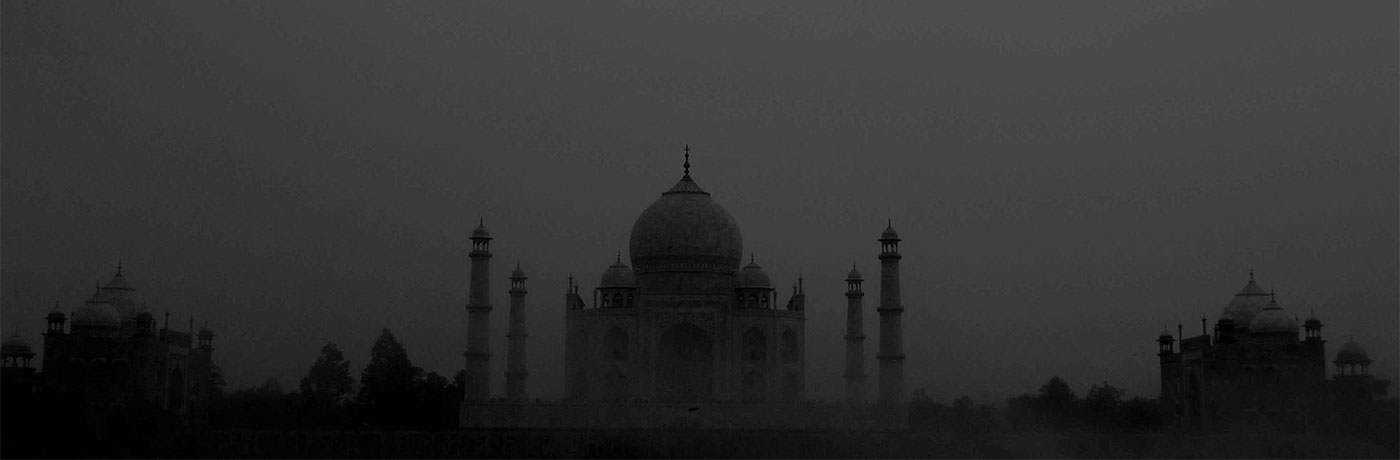
The final morning brings the journey to the Taj Mahal, where white marble, formal gardens and carefully balanced architecture create a striking contrast to the sandstone forts and desert cities visited throughout Rajasthan. Commissioned by Emperor Shah Jahan as a mausoleum for Mumtaz Mahal, the monument represents one of the finest achievements of Mughal architecture. Enter through the monumental gateway and take time to appreciate the carefully planned symmetry of the entire complex before approaching the main marble structure.
Closer inspection reveals the craftsmanship behind the Taj Mahal's familiar silhouette. Floral designs created through stone inlay, finely executed calligraphy, carved marble and the balanced arrangement of the surrounding buildings contribute to the monument's extraordinary visual harmony. The appearance of the marble changes subtly with daylight, while the Yamuna River behind the complex adds another dimension to its setting. Ending the sightseeing programme here creates a powerful architectural contrast with Mandawa's frescoes, Jaisalmer's golden fort, Mehrangarh's rugged walls and Udaipur's lakeside palaces.
After completing the visit, return to the hotel if required and prepare for the drive towards Delhi. Proceed to the airport or designated onward point according to the confirmed departure arrangements. By this stage, the route has crossed several distinct cultural regions of Rajasthan and connected them with two major centres of Mughal history, creating a broad journey through northern India's royal, mercantile, religious and architectural heritage.
09 Nights / 10 Days
Delhi – Agra – Jaipur – Pushkar – Jodhpur – Udaipur
06 Nights / 07 Days
Jodhpur – Osian – Jaisalmer – Sam Sand Dunes – Bikaner – Delhi
12 Nights / 13 Days
Delhi - Jaipur - Jodhpur - Jaisalmer - Udaipur - Delhi